Showing posts with label cycling. Show all posts

2.11.11

Back in the Saddle Again. Plus, Endemic Corruption in Cambodia

It’s safe to say that after cycling 3000 kilometers through Cambodia and Vietnam last year, I was harboring some major cycling nostalgia. But after recently riding a bicycle the 100 kilometers from the Thai border into Battambang, Cambodia, I can confidently say that the best way to cure nostalgia is to revisit it in person. This acts as an antidote to rehashing it in your mind.

IMG_1450

In other words, as I cycled up hill after hill, baking in the tropical sun, I often thought, “Oh yeah, cycling sucks sometimes. Hmm, I guess I had forgotten.”

Not to say that I didn’t enjoy myself. I did. The scenery, possibly because it was so hilly, was beautiful. Rolling green hills, luxuriantly green after the recent heavy rainy season. Fruit orchards on either side of a wide paved road. (Wide paved road? Where am I? Can this be Cambodia!?)

IMG_1455

About 50 kilometers into the trip, I met a man who had lived in Minnesota, often passing through my home state of Iowa. He spoke with an American accent and while I lay in his hammock, exhausted and sunburnt, he regaled me with stories and cultural references related to the states.

What I remember most, though, is what he told me about Cambodia. There’s a saying I’ve heard bandied about here: In Cambodia, the system isn’t corrupt; corruption is the system. I could illustrate this point with a laundry list of examples, but instead, I’ll relate something that my new acquaintance told me.

There are police checks along every stretch of highway in Cambodia and it’s no secret that these policemen will often pull you over and fine you for any offense—real or imagined, big or small. A truck driver who owned his own transport company said that he regularly paid over $2,000 US in these roadside bribes just to pass through the country.

None of this is a surprise. But here’s what I didn’t know, those policemen have to pay their supervisors (in dinners, socializing, and under-the-table bribes) to stand on that road. They often must pay up to $1000 US just for the privilege of standing roadside and, of course, the busier the highway, the more the police officer must pay to be there.

This puts things into a bit of (depressing) perspective, doesn’t it? Of course the policeman is taking bribes from vehicles. He needs that money to pay off his supervisor and he must keep paying his supervisor to keep his position. The supervisor, in turn, needs the bribe money to pay his superior and to keep his lofty position. Etc. etc.

As conspiracy theorists are so fond of saying, the corruption goes all the way to the top.

These thoughts kept me company as I cycled the remaining and tediously slow 50 kilometers to Battambang.

Another though which kept me occupied: Why are there so damn many Toyota Camrys in Cambodia?

25.5.11

Shelter and Sisterhood in Vietnam

This is the first in a series of posts dedicated to the amazing people I meet while traveling, people who provide me with much more than assistance. These are people who open their hearts to me and whom I will always think of as family. These are my angels of the road.

The following flashback is from my time cycling through Vietnam.

Cycling Trip 026

I was hungry after having only fruit for breakfast, so I stopped at the first place I saw. It was on the opposite side of the highway, though, which is something I try to avoid as this is no country road but the busiest highway in Vietnam. From my perch atop Bowie (the name of my bicycle), I could see the place served banh mi. Perfect. Since I had a jar of chunky, Vietnam-made peanut butter in my pack, all I needed was a little baguette (ridiculously cheap too—usually costing about $0.08) for the perfect, tasty lunch.

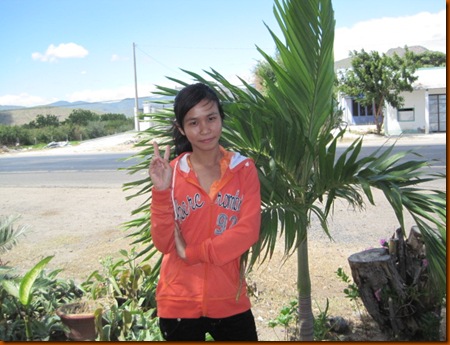
A young, slight girl who spoke some English approached me as I tried (awkwardly) to balance my bike and unload my small pack from atop the larger one. I walked with her and explained what I wanted, adding, “An chay” to make my bizarre choice of plain bread more understandable. Her father waved me over to sit at the table with him and his wife and daughters. I happily did, but, as he spoke no English, wondered what we would find to “talk” about for the duration of my lunch. We pantomimed about basic things, I showed them my map, and the daughter provided translations for the slightly more complex ideas.
Cycling Trip 029

Soon they were bringing out food and treats for me to partake in—candied ginger (a traditional Tet, or Vietnamese New Year treat), fresh papaya, watermelon seeds (damned difficult to open), a sugary puffed rice treat which was crispy and filled with ginger and crystallized sugar.

Then they started outright giving me things! The father packed up the container of candied ginger for me to take and added to it banh in—some kind of special Tet treat that was all white and sugary and rectangular. Then the daughter, An, brought out a heart-shaped gift box. I shyly opened it. Inside was a soft pink wide wristband. She indicated it was a scrunchy for my hair. How perfect! My pink sparkly hairband was in truly awful shape—dirty and stretched out and always catching and ripping on my tangled hair.

I was delighted, but also ashamed. What could I give to them? What did I have? Not for the first time I wished I was carrying a supply of gifts. Then I thought of my books. The Little Prince! It was filled with delightful pictures and the story was simple and maybe someday she would be able to read and understand it. So I fished through my backpack and gave it to her, trying to indicate through hand gestures just how treasured it was to me. “My favorite book,” I repeated.

I don't know exactly how it happened, but when we went back to the table to sit and I began rifling through my smaller pack in preparation to leave, An mentioned she wished I were part of her family. Then she said something to her father in Vietnamese, smiled and turned to me, saying that they would like it if I would be part of their family for that afternoon and night, that I should stay with them. I'm sorry to say that I hesitated. I really shouldn't have; it was an extraordinary offer. But in my defense, I was simply a bit concerned about time. So I got out my map again to see how far I had to go until Mui Ne, the next big town. Could I do the remaining distance in one day? Yes, it seemed completely plausible. So I smilingly agreed.

An was immediately jubilant. She jumped up from the table, lightly grabbed my arm and steered me toward a room in the back which had an altar and old photographs of the family's deceased relatives. She lit a long stick of incense then handed it to me, indicating that I should place the incense above the altar. I wondered, is this a ritual just for family members?

Cycling Trip 042

Then she led me into her room which she shared with two younger sisters, one fifteen and one twelve. She herself, despite looking much younger to my eyes, was only nineteen years old. She said I should feel at home and asked if she could call me Sister Sarah. I agreed, tickled by the ecclesiastical undertones, calling her Sister An in return. She invited me to bathe, which was a welcome invitation after a few hours cycling in the hot sun. I bathed quickly in the outhouse, splashing myself with water and washing my hair as best I could. Around An and her sisters, all of whom dressed neatly and meticulously, I had been acutely aware of my sweat-stained outer shirt and tangled, messy hair.

After a light lunch, the girls showed me a video of An singing beautifully at some kind of celebration. She had a lovely voice and did some very sweet dance moves, all while wearing a cowgirl-inspired outfit which might have been ridiculous on someone else, but she was such a cute little thing, I think she could have worn anything. Then we did some karaoke, and after a little persuasion I too decided to sing. I started with “We Wish You a Merry Christmas” because it was the only English song, then I passed the microphone to the sisters. The eldest two had simply stunning singing voices and moved with such grace and ease. 


The sisters told me I was beautiful, even before I had bathed my fatigued, sweaty body. And they loved my hair. But I didn't see how they could truly think I was beautiful. Oh, that's not self-deprecation. It's just that I violate so many Asian standards of beauty, especially now. I have dark, tanned skin. Really. My legs are the color of a roasted turkey at Thanksgiving. I have freckles and I am too tall and too big and too clumsy. In many ways, I am the antithesis of the standard of beauty here, in which being graceful and pale, with as white skin as possible, is seen as beautiful. I think the only way to reconcile this paradox is to agree that the sisters were holding me to entirely different standards of beauty. So while they may find me beautiful, they would never want my dark tan or my freckled skin.

 Cycling Trip 045

That afternoon, though it was clear that the normal activity would have been to sleep a bit, we all piled onto the family's motorbike. The girls took great care in preparing for the trip. They wore face masks and long gloves, as well as hoodies with long sleeves and the hoods pulled over their heads and tied tightly under their chins. In contrast, I wore my cut-off jean shorts and a short sleeve shirt. I was already as dark as I'd ever been and, while cycling ten hours a day, I simply found it useless to fight the tan. So the four of us squeezed on and rode into the nearby town of Vinh Hao, famous for its mineral water, to take the type of photobooth kitschy photos that are so popular in Japan. You know the ones—you can edit them afterwards, adding bows and hearts and writing to the foreground and a snowy background or a background populated by Hello Kitties. We drank sugar cane juice with ice and a bit of orange juice mixed in, which Sister An insisted on treating me to.

The sisters took a little nap and bathed before dinner, and as she was changing her clothes, An asked me a question I never expected to hear. “Do you think I'm thin?” she asked, her face tight and worried. My goodness! “Of course you are thin!” I answered immediately, knowing the crushing effect of hesitance. This girl was tiny, tiny, tiny. She was pocket-sized—as slim and slight as a child. Why on earth would she worry about a thing like that? But I understand. Girl, do I ever understand. Beauty standards infiltrate and insecurity abounds in everyone; the skinny and the symmetrical are no exception.

Cycling Trip 041

I felt like an oaf in comparison to her and in the past few months I had gained weight and no longer recognized my own body. But I was beginning again to feel comfortable in my skin. Especially once I started cycling—on that first day, with no preparation or past experience, I cycled 75 km—I really began to see what my body was capable of and it made me grateful. Grateful for strong legs and strong lungs. Grateful for a constitution which, after cycling for ten hours can still be vibrant and full of energy, propelling me out of my hotel room and exploring whatever town I'm passing through.

I met some of the extended family at dinner—aunts and uncles. We conversed through smiles and laughter and soon An translated her uncle's complimentary comment on how tall I was. They were all impressed with my stately height. Well! At 5’4” or 153 cm, this was certainly a new experience! But he was right. I was a bit taller than him and a few good inches taller than everyone else in the family.

After dinner we lay and watched TV on a woven mat on the floor. An's middle sister brought out pillows and blankets, and so, instead of using the girl's bedroom, we fell asleep there on the floor. All the women in the family—An's mother and her sisters and now me—slept in the open air of the front balcony of their house/roadside restaurant. Though An's mother joined us on the floor, I was aware that she got up several times during the night to serve hungry customers. Their restaurant was located on the busiest highway in Vietnam, after all.

I awoke with the light, as did the entire family. I efficiently gathered my things; weeks of experience had made packing up a well-worn routine, and I was soon saying goodbye to the lovely family that had taken me in and embraced me.  I hugged and kissed them all in turn, saving the biggest hug for Sister An. I saw myself in her—someone endlessly curious about people and the world. I saw in her what I wanted to be—someone open, caring, courageously sharing herself with strangers.

I couldn’t linger; I had a long way until my next stop, Mui Ne. But as I cycled off, I wished I could shelter Sister An somehow, shelter her from the pain that comes with such openness, shelter her from the insecurity of caring what other people think. But who am I to lend her strength, I who know the pain of bending under the weight of my own insecurity? Maybe we can shelter each other, maybe we provide each other with support, with—what is the word? oh yes—sisterhood.

23.4.11

Tales from Vietnam. Cycling over Mountains and in the Dark

The following is a flashback from my time cycling in Vietnam. It recounts the time I was nearly stranded on top of a unpopulated mountain at dusk with no tent, no water, no warm clothes, little food, no sleeping bag, and no flashlight.

Cycling Trip 280

So I pressed on, thinking, if necessary, I could flag down a bus. Almost immediately the road began to climb. And climb. I optimistically expected the road to reach the peak around every corner. No such luck. I don't know if there is any way to impart the experience that afternoon. The uphill seemed endless, and in fact, it continued uphill, often steeply, for 20 km and those 20 km took me at least 4 hours to complete. When the grade was too steep (it was quite often 10%) or when my legs were simply jello-like and sore, I got off and pushed the bike until my arms were jello-like and sore; then I either took a break or switched again to riding.

Cycling Trip 242

It was the hottest part of the day and the sun was merciless. I can say, on the bright side, that the scenery—the surrounding mountain view—was stunning. Cliché! My breath was taken away from the climb and then again from the view! ;)

Despite the view, though, I was exhausted and when I looked at my cell phone to check the time after noticing the air around me was chill, I saw it was getting on to 3:30 p.m. and the mountain, the uphill, had no end in sight. "Give it some time," I thought. "I can always flag down a bus in a half hour or so."

So I continued up and up and up. Soon it was 4:20 p.m. and the road ahead had a sign declaring a 10% uphill grade. So I flagged down a bus that was going to Da Nang. But they wanted 20,000 VND which struck me and still strikes me as exorbitant. So I waved goodbye to them, wondering if I'd regret it later. (Spoiler alert: The answer is yes. And no.)

So I continued on—nothing to do but move forward. And lo! What's this? A downhill! Yes!

I cruised down the hill, thinking, "This is it! The crest of the mountain." Exuberantly, I used my newly defined phrase: "It's all downhill from here!"

Cycling Trip 278

I passed through a tiny village and three boys lined up and held out their hands to high five me as I rode by. I felt joyous, unconquerable. I passed two policemen; they tried to say something to me. Wary, I smiled and waved and kept going. I passed a waterfall, right in the nook, the armpit of the road's curve.

And then I turned the corner. "Motherfucker!" I thought, along with other obscenities. Another uphill sign!

Cycling Trip 252

This sign indicated only 150 m, but I knew all too well that those 150 m could drag on for kilometers. I felt completely dejected. I ate a tangerine. Now I had no water and only two tangerines. It was late, past the time when most minibuses ran and it was cold. I waited, hoping to flag down a minibus, but none passed. I had no tent, no sleeping bag, no sweater, no flashlight, no water. The situation was feeling a wee bit desperate.

I gave myself until the end of the tangerine, then when no minibus had passed or could be seen approaching, I had nothing left to do but keep moving. The white and red stone kilometer markers on the side of the road indicated a town 9 km away. Even if it was uphill the whole way, surely I could make it around dusk and find a home to sleep in! So I trudged up the hill. And it was, blessedly, the last!

Cycling Trip 284

It really was downhill from that point on, which was lucky because I soon found out that the "town" the kilometer markers were counting down to was not a town at all. It was a waterfall.

So I kept going. The going was easy now—all downhill. Not to mention, there was absurdly beautiful scenery at every turn. It seemed once I had reached the crest of the mountain, the climate suddenly and very noticeably changed. On the way up, the mountains had been arid, often with exposed patches of red dirt and patches of dry, brownish grass. Once on the other side of the pass, the air became absurdly thick with moisture. Every breath I took was like drowning in warm water and the mountains had no dry patches, no exposed dirt. Instead they were filled to bursting with ferns and palms and vines and greenery of every sort. I could hardly believe the lushness. At every turn there was a waterfall.

I stopped often to take pictures but soon realized I had no time to dawdle. I saw a kilometer marker for Kham Duc—my original destination—for about 25 km away. It was already dusk, but I was making great downhill time, so I decided I would try to make it. I might have to cycle a bit in the dark, but so what?

So I pushed on, as fast as my legs and the hill would take me. And the kilometers quickly ticked by. It was just that time of evening when the bugs are out in full force. This fact, coupled with the extreme humidity, soon meant my face was speckled with little black bugs.

With 10 km to go, darkness fell completely. I cycled on, using the weak flashlight mode on my cell phone and holding the phone in my left hand so I could try to make out the road in front of me. The traffic was not too thick, but I still feared some crazy driver (of which there were plenty) would swerve into me in an inattentive moment. But luck was on my side and a little after 8:00 p.m. I finally made it into Kham Duc and though I entered the town slowly and with little fanfare, I felt as if I were in a one-woman parade. I felt like celebrating.

22.4.11

Power Snacking in Vietnam and Cambodia

I often tell people that Southeast Asia, especially Vietnam, is tailor-made for cycling. All right, so the roads aren’t always great (see this post as proof), but the drivers are accustomed to cyclists, the hotels are cheap, the scenery is phenomenal, and the food is amazing and very suitable for vegans. The snacks especially are plentiful and healthy, providing the perfect source of long-lasting energy.

Cycling Trip 129

In Cambodia, if you see a roadside grill like this, pull over. Immediately.

Cycling Trip 133

At first I was too shy to buy any of these little packets as I wasn’t sure what was inside them. But soon I realized that at about $0.12 each, I could afford to take a gamble and open one up, hoping for a vegan filling! There’s something remotely Christmas-like about peeling away the charred layers of banana leaf to reveal the treat inside.

Cycling Trip 132

This particular variety (called something like An Som or Anksom) are popular near Kratie. The most common type is as pictured above—sweet sticky rice boiled with coconut milk and a hint of salt wrapped around a banana and then grilled. The rice becomes chewy and a bit crunchy while the banana practically melts and caramelizes. Beautiful. I also found these stuffed with taro and (my very favorite) shredded jackfruit.

Cycling Trip 315

Here’s a snack I was only able to find once in Vietnam, though I searched for it many times as it was truly the perfect cycling boost.

Cycling Trip 316

I’ve searched for more information in vain, but here’s what I can tell you about it. It was a chewy confection made from black sticky rice, black beans, fresh ginger, a bit of sugar, and topped with white sesame seeds. It filled me with energy and protein without weighing me down and the fresh ginger was an unexpected and invigorating touch.

Another one of my favorite cycling snacks in Camboda is krolan—sticky rice with coconut cream and black beans stuffed in a bamboo tube and cooked for hours over low heat. It’s labor-intensive work, as the tubes must be constantly monitored and turned to prevent burning. But the result is unique and delicious, and as with the above snacks as well, the packaging is sustainable and biodegradable—perfect for when you’re on the bike!

5.2.11

The VVR (Vietnamese Vegetarian Restaurant)

Besides asking “Why on earth?”, the first thing people ask me about my veganism is “But isn’t that difficult?” The answer is, in some places more than others. Eastern Europe for instance, especially outside the major cities, is difficult to be vegan and healthy in without access to a kitchen.  But Vietnam, ah Vietnam! For ease, health, and deliciousness, Vietnam has been one of my favorite countries to eat in. This is due mainly to what I term as the VVR—Vietnamese Vegetarian Restaurant.

Cycling Trip 080

Mock pork, mock fish, stir fried green beans, and a sweet and sour pineapple, tofu, and veggie dish.

The Vietnamese practice Mahayana, a different type of Buddhism than their neighbors in Thailand and Cambodia. Mahayana Buddhism recommends eating a vegetarian diet for all followers, and requires it of monks. For four days each month, including the new and full moon, a vegetarian diet is practiced by many pious followers of Mahayana Buddhism. Consequently, the concept of eating no animal products is well known and often even respected as a sign of great piety. Another consequence of these four days is that every major and some minor towns tend to have at least one VVR which caters to the religious all month and is naturally more popular on one of the recommended vegetarian days.

Cycling Trip 073

Silken tofu soup, stir fried green beans, spring rolls, and a dipping sauce.

Vietnamese is written in a modified Latin script, which makes reading signs faster and easier, so even while I was cycling down the road, I could scan the signs for those magic words:  Com Chay (Vegetarian Food).

Cycling Trip 017

Because the VVRs cater to the general population, their prices are low, very low. All meals I ate across the country cost less than 20,000 VND, with most costing just 10,000 VND. Most have no English menus at all, no English spoken, no tourists. In fact, I can only remember one time when I went into a VVR and saw another Westerner eating there.

So how did I know what to order? In general, you have two options at a VVR. The first option is to choose from a short list of made-to-order noodle soups. Each VVR tends to offer different soups based on the region and the restaurant’s specialty, but some common choices are pho, bun, and mien. (See my previous post to learn more about these noodle soups.)

DSC_0195

Noodle soups with a glass of fresh soy milk. Photo courtesy of Nathan Edgerton.

The second option is to order a plate of rice which comes with a selection from the “buffet”. The buffet is a daily range of dishes which you can peek at and sometimes select yourself, but which the proprietor will arrange and serve atop your pile of rice. The daily dishes usually cover quite a range—from a brothy vegetable soup to saucy mock meats to rainbows of stir fried veggies to fresh spring rolls. Some restaurants even serve further specialties like hot pot, banh xeo (filled savory crepes), banh mi (baguette sandwich), freshly made soy milk, and banh bao (steam buns).

Cycling Trip 196

Sauteed greens, steamed pumpkin, lemongrass “chicken” (which used a stalk of lemongrass to replicate the bone), and a brothy green-filled soup.

31.1.11

The Nature of Hospitality

“Cambodians are different. They are not hospitable,” Chu, a surveyor from Shanghai who was working in the northeastern Cambodian province of Ratanakiri, told me this when I stepped off my bicycle for a break. Later, as I cycled on the desolate red dirt road between Kratie and Banlung this thought stuck with me, bouncing around in my head like tennis shoes in a washing machine. I agreed with him and pined for the hearty hospitality I had been shown while hitchhiking in eastern Europe and Turkey. I rode this train of thought as I rode my bicycle, slowly and ponderously. I was tired and lonely, the road was unmarked, there were no towns or other landmarks to speak of, and my map was proving inaccurate. Hotels awaited me in Banlung, but I had another full day of cycling until I would reach them. Consequently I didn't know where I would sleep that night.

Cycling Trip 154

How did I get here? On this desolate road in the buttcrack middle-of-nowhere Cambodia, covered in red dirt, which seemed to permeate my pores and settle into every exposed crinkle in my skin. As I rode along, I imagined myself talking to someone who was thinking of cycling in Southeast Asia. What would I tell him or her? “Don't do it.” Yeah, that'd be the first thing. I had only been on the road for six days, but those were five miserable days. It rained constantly the first two days, despite this being the dry season, and even my long pants and wool sweater were not enough to keep me warm. Then after the rain, the shitty roads began. Dirt had turned to mud, a thick red mud which made traction impossible and pushing my bicycle a necessity at times. Soon after, I began to miss the mud as it was replaced by powder-light dust which came at me like a tidal wave of red dirt every time a motorbike, car, or truck passed me. The soreness abated quickly but still lingered on, especially in my ass, crotch, and lower back. But the worst of all was the loneliness. For six days I had spoken nary a word of English beyond “hello”. Instead I spent ten hours a day on my bicycle, my thoughts on constant repeat. Did I spend the time pondering my plans, my aspirations, my goals? Not at all. Something about the repetitive motion of the bicycle, the repetitive scenery, the physical exertion seemed to make any sort of philosophical pondering impossible. Instead I spent the time decrying my state and setting tiny goals for myself to keep me on the bike and cycling as much as possible. So even for mundane activities like checking the map, getting a drink of water, putting on my gloves, and applying sunscreen, I would make myself wait as long as I possibly could just to eke out every extra kilometer.

Cycling Trip 138

The entire day I passed by the same dusty landscape—spindly trees and tall grasses which were as coated in powdery dirt as I. Around 5:30 p.m. the sky started to darken and I knew I had about a half hour of good light left so I began to search for a house I could ask to sleep in. I stopped at the first house I saw and bought a bottle of water. The whole family was huddled on the ground using large metal soup spoons to scoop up and reserve some oil which had spilled on the packed-dirt ground. I isolated the matron of the family and as I paid for my water I made a sleeping pose, then shrugged my shoulders in a cartoonishly exaggerated questioning pose. She stared at me for a bit, then nodded vaguely. I smiled and said, “Akuhn.” I didn't know the logistics of my sleeping arrangement, but she had agreed, so at least I would not be sleeping on the side of the road that night.

Cycling Trip 117

I was coated in an opaque layer of red dirt and my junk was feeling a bit itchy. I guess the dried urine combined with tight bike shorts and long hours pressed to the bicycle seat was not agreeing with me. I asked where the bong khon was, only to find that they didn't have one. But I saw the eldest daughter splashing in some water in a small basin out back, so when she was finished I grabbed a half-filled water bottle and a change of clothes and squatted on the flat rock which acted as both kitchen sink and shower. They didn't have access to running water, so I used the drinking water left in my bottle to quickly rinse the most crucial areas.

I sat at a table at the front of the house with my journal and wrote as the light faded around me. There were three children in the family—two teenagers and a young girl. The youngest was inquisitive and came to peek over my shoulder as I wrote. I showed her the half-filled page, then put my journal down and began to draw in the fine dirt around us. First I drew simple shapes—a star, a heart—then started writing basic English words, pronouncing them slowly as I did. “Hello. OK. Bye.”

Just as it became too dark to write, around 6:30 p.m., the father pulled up to the house on the family's one motorbike. Almost immediately I heard the chugging of an engine turning over and then the constant whirring of a generator. The lights came on and the two teenagers, clearly well versed in this routine, turned on the television and stereo and popped a disc into each. As the mother prepared dinner, the remaining members of the family, as well as a few neighborhood children, gathered around the television. I can only imagine the name of the disc was Extreme Bloodlust 3 or something of the sort, as the “movie” consisted entirely of the bloodiest scenes from all the Rambo movies, spliced together with nothing so distracting as dialogue or exposition between them. Not that we would have been able to hear any dialogue. Instead, a mix of Khmer and American dance music blared over the speakers, including my favorite Khmer rap tune called, as far as I can tell, “Mien Loy,” which translate to have money though is used in this sense to mean payday. The lyrics, as they were earlier translated to me, are something to the effect of “I've got money, so I'm going to ride on my motorbike and buy some beef.” I appreciated the prosaic, mundane lyrics—a far cry from the seeming-hyperbole of their American rap counterparts. I tried to continue writing in my journal under one of the three light bulbs hanging from the bare ceiling, but the gruesome scenes on the television entranced me. As I watched Sylvester Stalone slash and shoot everyone around him, an American hip hop song I had never heard came on the stereo. The lyrics were pure poetry: “Don't want no short dick man. Don't want no short dick man. Eeny weeny teeny weeny shriveled little short dick man.” I smiled as I looked around at the four or five young children gathered around the television.

When the matron of the house came out with dinner—a big covered bowl of white rice and a smaller bowl of meat and vegetable stew—the neighborhood children left and the family relocated, their necks craned so they could still watch the television, to the dining table. The mother offered me a bowl, but I declined, saying, “At nyam satch. I don't eat meat. Nyam bai. Eat rice.” This simple phrase accounted for about half of all the Khmer I knew, and didn't entirely get my point across, as the phrase nyam bai, though literally meaning eat rice, is more commonly used to refer to eating in general—such is the importance of rice in Cambodian culture. But after a little gesturing she handed me a bowl of hot white rice and I topped it with soy sauce. I cleaned my bowl quickly but felt far from satiated.

So it was with a half-empty stomach that I prepared for sleep. It was about 7:30 p.m. and the family was closing up their house for the night. The mother brought out a tiny pillow, placed it on the table I had eaten dinner on, then joined her husband and three children on a wooden platform no larger than a full-size bed. The platform was covered in a flat, primary-colored plastic woven mat and sheltered by a light blue, rectangular mosquito net. The family huddled under one blanket and shut off the light. I contemplated my makeshift bed. Just thirty minutes prior I had eaten my bowl of rice on this table. Despite the early hour, I was tired, so I put on my warmest clothing—a pair of cotton pants, short sleeved t-shirt, and a wool sweater—and climbed up on the table.

I slept fitfully, turning from side to side whenever my hips became bruised, laying on my back until my tailbone ached. Around 2:00 a.m. my warmest clothes were no longer warm enough. I slept nonetheless.

Cycling Trip 155

The mother arose and began making rice around 5:00 a.m. and when I got up at 5:30 a.m., the kids were still sleeping. I shuffled around a bit awkwardly as I tried to say my goodbyes. I fumbled with my purse, but the mother would not accept any money. Instead she smiled quietly and gracefully as I tried to communicate my gratitude by pressing her hand and saying, “Akuhn,” over and over. I got on my bicycle and waved an enthusiastic goodbye. The air was soft and cool and the sun cast long orange shadows on the red dirt ground.

As I cycled on the silent road, reflecting on my night, I felt a familiar pang of guilt. The family had opened their home to me and allowed me into their lives. All I had left them with were some scribblings in the dirt, a few smiles, and hopefully a story to tell.

6.1.11

Interview with the Vagabond: Segond Fidens


First in a series of interviews with some of the fascinating people I meet while traveling. These are people who are traveling long-term and/or traveling in unusual and inspiring ways.

Segond Fidens is a Rwandan by nationality but is now studying in France. I met him in the Mekong Delta of Vietnam when we were cycling in opposite directions. We've kept in touch since because he is one of those rare visionary travelers whom I feel fortunate to meet. He started his cycling trip in Beijing and finished in Bangkok, cycling in total around 8000 km in 100 days!

His next plan is an ambitious cycling and walking tour starting in western Europe and making its way through the middle east then across the entire African continent.


1. What motivates you to travel?
Curiosity, responsibility, self-discovery, uncertainty and discomfort; adventure and more.

2. How do you decide where to go?
I decided to travel throughout all southeast Asia to discover the real genius of China and the secret behind the recent economic breakthrough.

3. What was the darkest moment in your travels? Was there ever a time when you wanted to shove it all and go home?
The darkest moment in my travels was when I got my bike's nails screwed up by a Cambodian bike repairer, just because I attempted to negotiate the price after the operation. But I have never thought about quitting. There is not enough trouble to make me give up.

4. What does home mean to you?
Home to me means a place where people tolerate you enough and let you feel helpful.

5. Where is home?
Home is where I am needed the most.


6. Do you prefer to travel alone, with someone, or in a group?
I prefer traveling in two. It's better to have someone to share with.

7. What is most important to you when traveling: meeting people, seeing beautiful buildings/landscapes, having interesting experiences, eating local cuisine, giving back in some way, etc.?
To me what's important is to be able to learn from the local people, their culture and the best practices they have developed.

8. How do you finance your travel? Any tips for a frugal traveler?
People's generosity works. Little savings may lead you to be humble in spending.

9. What's the stupidest thing you've done while traveling? Something that would give your mother a heart attack if she heard about it?
The stupidest thing I have ever done that would make a mother cry is abandoning my studies for a wild bike ride throughout Asia.

10. What place(s) that you've been to could you see yourself living in long term?
Salem (Oregon). Mountains, water ... and people. They'd make me want settle down.

11. What was the single most delicious meal you ever had on your travels?
The most delicious meal of all is the egg-fried rice (Dan chao fan). China is not big enough for every taste's sake ...

12. Name a spontaneous act of kindness that you received on your travels.
Trust and sympathy are the most humane and sensitive feelings that I encountered during my travels.

13. Are people the same everywhere?
Yeah... Good spirits are waving and framing our journeys. And they are everywhere we want to see them.

14. Have you ever changed your plans because you met someone with whom you had a connection/friendship?
Most of the people I met had interesting plans, but they weren't exactly fitting to mine, so tending to change was tempting but I needed to stick to my previous plan.

15. Why did you stop traveling?
I stopped traveling because I need to get my degrees before hitting the road again. 2012 is coming fast, the plans are on the desk and Sarah is in, hopefully.

4.1.11

Cycling in Cambodia: Videos from the Road

Cycling along the Mekong river between Kompong Cham and Chhlong. The river is not visible here, but it is never far off. You can see how its proximity affects the style of housing in this region. Here, as with every populated place I cycled in Cambodia, I was greeted with a rousing chorus of hellos.

Cycling in Cambodia: Videos from the Road

A video I took while the day was drawing to a close. You can spot my long shadow in the lower left corner on occasion. This region (northeastern) is one of the most sparsely populated in the country. I went three days between towns here--only seeing a stingy sprinkling of houses. The loneliness was at times difficult, but it was also a gift. During this stretch of my trip, I began to feel liberated from sanity, a phenomenon of which I will write more later. Until I found myself liberated from its constraints, I had never before considered sanity a boundary I would want to break through!

29.12.10

Where did I sleep last night?

My traveling, my life, has a soundtrack and often particular songs are inextricably linked with certain places or memories. In line with this phenomenon, I'm starting a feature called (cheesily) melodies and memories.


When I started cycling through sparsely populated northeastern Cambodia without a tent or any camping equipment, I soon realized that I would need to think creatively about where to sleep each night. So every evening around 5:00 p.m. as the sky started to darken, I kept watch for the next house and would pantomime to the owner my desire for a place to sleep. I often slept on the floor (naturally):

but the strangest place I slept was on a family's dining table as they didn't have enough floor space.

Because I never knew where I would sleep each night, and because I had ten or eleven monotonous hours on the bicycle, I began singing, as if on continuous repeat, Nirvana's Where Did You Sleep Last Night, especially as dusk began to fall.

27.12.10

Vietnamese Noodle Soups

One of the delights of traveling anywhere in the world is sampling the cuisine. As a vegan, this delight occasionally turns into a challenge, albeit a delicious and surmountable one. Vietnam, with its tradition of vegetarian cuisine, was one of my favorite countries to eat in, and nothing got me geared up (snicker!) for a day of cycling like a bowl of noodle soup for breakfast.

Observe:
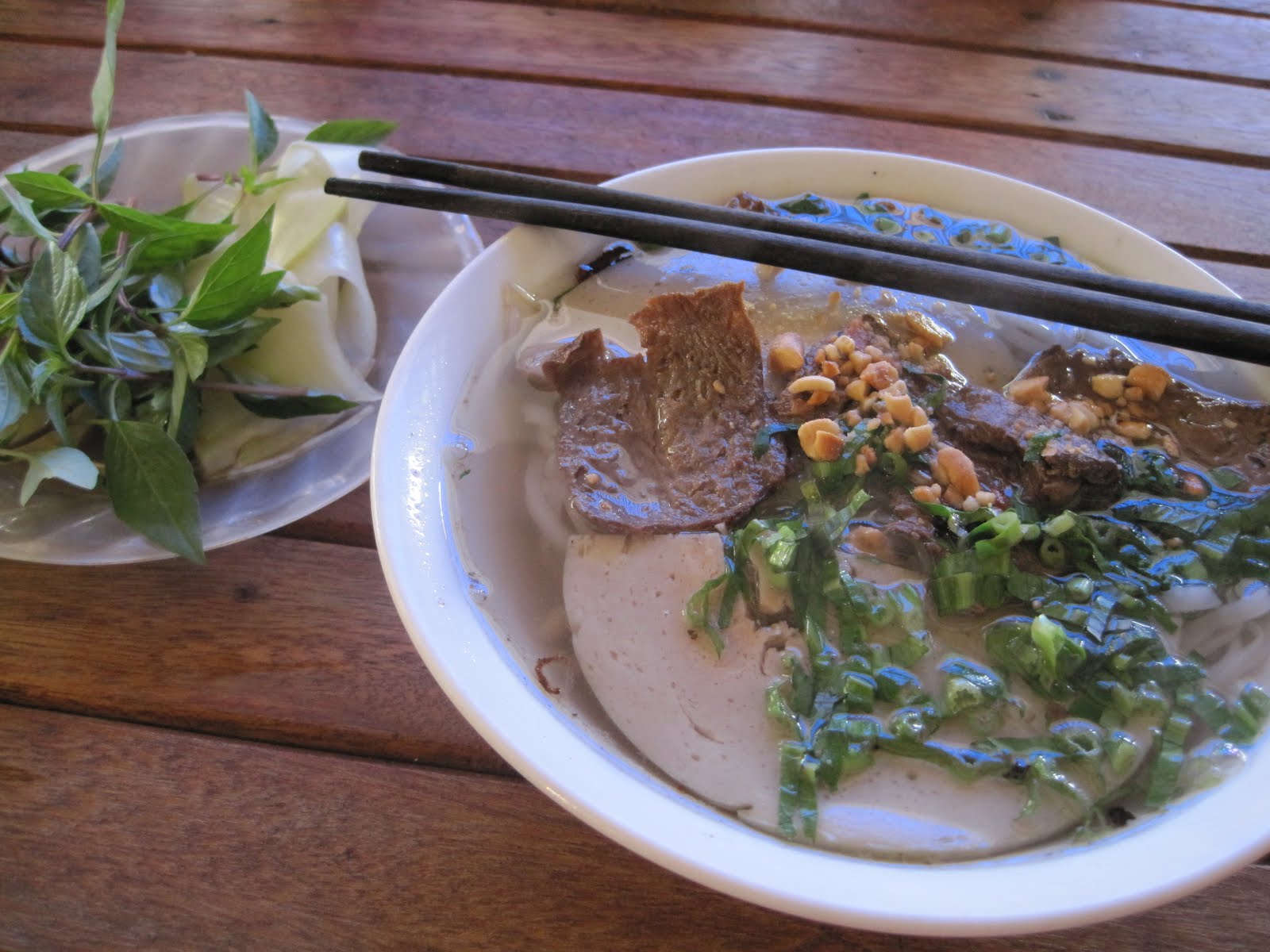
Pho in Quy Nhon. Pho is the classic Vietnamese noodle soup. It's made from thick flat rice noodles, beef (or mock beef in my case), and is served with a heaping side plate of herbs, including basil, mint, lettuce, fish mint, and lime wedges.

Mien is made from clear cassava vermicelli noodles.

Bun from Quang Ngai. Bun is a rice vermicelli soup in an acidic, light broth. As you can see, it, like Pho, is served with a side plate of herbs which are then added to the hot soup. Some people only add a few leaves, but I preferred to scoop the whole plateful into my soup.

An exceptionally citrusy and refreshing bowl of Bun Hue from Hoi An. I first sampled noodle soups outside the tourist center of Hoi An in a small Vietnamese vegetarian restaurant which had more in common with a garage than a Western restaurant. For 10,000 VND, or about $0.50 USD, noodle soups made the perfect energizing brekkie for a long day of cycling.

The Hoi An specialty, Cao Lau. Features rustic, square wheat noodles and water from a specific well in Hoi An. The noodles are pleasingly toothsome and the soup is topped with crispy fried noodles as well as the usual (though always vendor-selected) range of fresh herbs.

My first bowl of Pho Bo! A perfectly balanced revelation. The broth is made hours ahead of time then kept on low heat the whole day, while the noodles are cooked to order. This makes the assembly truly fast, as flash-cooked noodles are carefully topped with a ladleful of broth, bits of meat (or faux meat), bean sprouts, and fresh herbs. Condiments like sugar, hot peppers in vinegar, crushed peppers, and sometimes MSG are placed on each table so every customer can customize and create his perfect bowl.

3.3.10

The adventure begins


Oh Lordy, could I be any cheesier?

Here's the story, told some six weeks later. I've polished it up a bit after multiple tellings and retellings. After the aforementioned punch in the gut, I wandered the streets of Phnom Penh. Should I go to Vietnam or Laos? The question pestered me. If limes can be trusted, the answer was Laos. But limes might be fickle and Justin has good aim. Let me back up even further. "Laos or Vietnam?" I asked my friend, the imperturbable Justin. "Let's solve this in the only suitable manner," he replied (or, possibly, I'm fabricating this entire speech). "See those two pots hanging on the wall?" I did. "The left one is Vietnam; the right one is Laos. Whichever pot this lime hits," he picked up a lime from the lime basket on the table, "is the country you'll go to."

"Well, this sounds entirely reasonable," I responded.

"Thump," went the lime as it hit Laos.

Laos it was.

But days later, the question still nipped at me. And so I wandered the streets, unable to make even the most mundane decisions. I needed to flip a coin to decide where to eat lunch. Then, in one moment, everything changed. I walked past The Vicious Cycle, a bicycle shop near the riverside, and I thought (God, it's fucking tempting to add, completely unnecessarily and against all rules of style, "to myself" after those two words), Why not? I don't want to take the bus, but hitchhiking hasn't been working out. Why not cycle?

Once I made the choice, everything fell into place. It seemed the universe was smiling on my decision. For as I walked to the Russian Market the next day, dodging street sellers, refuse, and the near-constant chorus of "Moto madam?" and "Tuk tuk miss?", I passed a hole-in-the-wall bike repair shop with four used mountain bikes for sale. The owner, a former resident of Atlanta, Georgia, quoted me a reasonable price for the shiny white beauty with big front and rear shocks I was eying and he agreed to show me some basic repairs.

The next few days passed quickly, as I ducked around the city in a haphazard manner, collecting the gear I would need for my trip.

I decided I would cycle through northeastern Cambodia before crossing into Vietnam, but beyond that outline, my route was hazy, and I preferred it this way. No sense in making plans that would be changed anyways.

So, four days after purchasing my bicycle, I crossed the Mekong River and rolled out of Phnom Penh.